Home > Learner Induction
Introduction to iPET Network Qualifications
Welcome to iPET Network
Congratulations on registering for your iPET Network qualification.
This page introduces you to iPET Network and provides important information to help you understand your qualification journey. Please read it alongside your Learner Qualification Overview and the Qualification Specification for your qualification.
Together, these resources explain what to expect, what you need to do and where to find support. Please take time to read them before you begin and refer back to them throughout your qualification.
The content on this webpage belongs to iPET Network Ltd and is protected by copyright. It is provided to support you during your qualification. Please keep any confidential information and learning or assessment materials secure, and do not copy, reproduce or share them without permission from iPET Network.
You Approved Centre and Awarding Organisation
Your Approved Centre is the organisation you study with, sometimes called your training provider. Your Approved Centre delivers your training and learning, supports you during your qualification and arranges your assessments. Your Approved Centre is your first point of contact for questions about your training, submitting work and receiving feedback.
Your Awarding Organisation (AO) is iPET Network. It does not deliver your training. Instead, it develops the qualification, sets the assessment requirements and checks that Approved Centres meet its standards. It also awards your qualification and issues your certificate once your achievement has been confirmed through the required checks.
Guided Learning Hours (GLH) and Total Qualification Time (TQT)
Each qualification includes a Guided Learning Hours (GLH) value and a Total Qualification Time (TQT) value.
Guided Learning Hours (GLH) are the hours during which you are being directly taught, supervised or supported by a tutor, assessor or trainer.
Total Qualification Time (TQT) is the total amount of time an average learner is expected to spend achieving the qualification. This includes Guided Learning Hours as well as independent study, research, practice, assessment preparation and completion of assignments or assessments.
GLH and TQT are not the same as the qualification registration period. A qualification may have a registration period that is significantly longer than its GLH or TQT. This allows flexibility for learners, employers and Approved Centres to plan learning around work, family and other commitments, while also allowing time for assessment, marking, quality assurance activities and certification.
If you use an e-portfolio system, the dates shown against individual units or assessments are usually target completion dates, designed to help you progress through your qualification at an appropriate pace. These dates will be earlier than your qualification registration end date and do not necessarily indicate when your qualification registration expires. Keeping up with these target dates helps ensure there is sufficient time for assessment, marking, quality assurance and certification before the end of your registration period.

How does my qualification get quality assured?
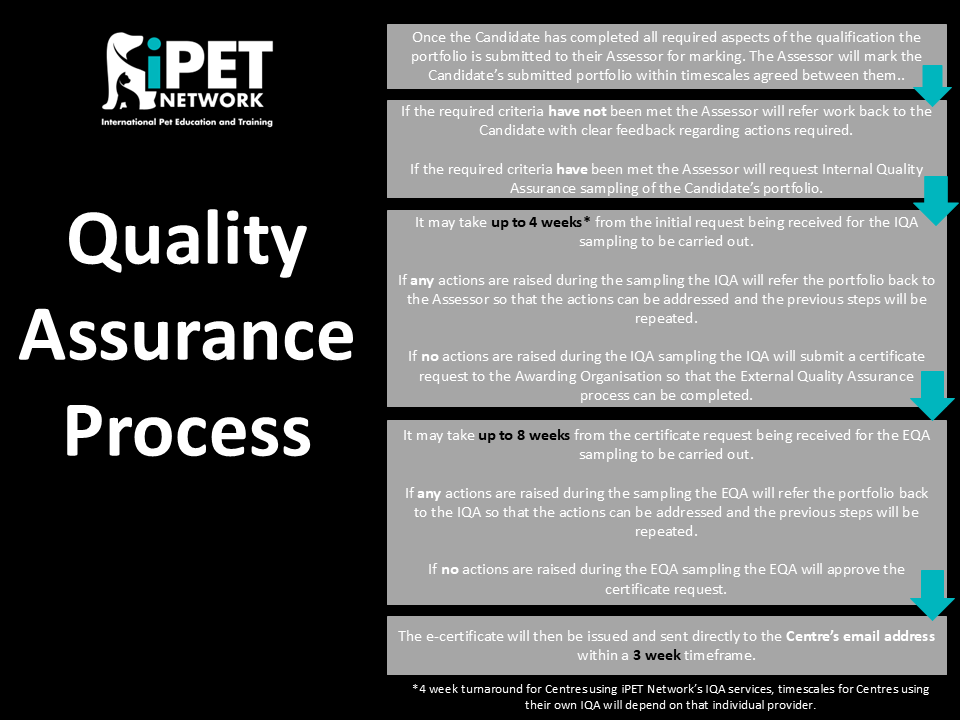
Our qualifications come with a tight quality assurance process; this ensures the quality of the qualification is maintained.
Contact your Approved Centre for updates on your progress through the process.
Once you have completed your assessments, there may be a period of quality assurance checks before your qualification can be awarded and your certificate issued.
The time required will vary depending on the qualification and the quality assurance arrangements in place. Some Approved Centres carry out their own Internal Quality Assurance (IQA), while others use iPET Network’s IQA service. Where iPET Network provides the IQA service, we aim to complete IQA activities within four weeks of receiving the notification that assessment is complete and all required documentation.
Qualifications are also subject to External Quality Assurance (EQA) checks. Where EQA is required prior to certification, iPET Network aims to complete these activities within eight weeks of receiving all relevant information. Not all qualifications are subject to EQA before certification.
These timescales represent our service standards and should not be regarded as a guaranteed certification date. Certification can only proceed once all required quality assurance activities have been successfully completed.
If quality assurance checks identify actions that need to be completed, such as requests for clarification, additional evidence, assessment amendments or further sampling, the process may take longer. Any required actions must be satisfactorily completed before certification can be considered. Delays may also occur where information, evidence or responses are outstanding.
Your Approved Centre can advise on the quality assurance arrangements that apply to your qualification and provide updates on your progress. To help avoid unnecessary delays, please respond promptly to any requests for information or evidence.
The process is detailed in the image adjacent.

Registration Periods
All iPET Network qualifications have a maximum registration period. The registration period for each qualification is published in the relevant Qualification Specification, available on our website.
The registration period is the maximum time available for completing all qualification activities, including learning, assessment, practical activities (where applicable), assessor marking, quality assurance and certification. Learners should not leave completion until the end of the registration period, as sufficient time must be allowed for marking and any required quality assurance activities before certification can be issued.
Your Approved Centre will agree an individual learning plan with you, including target dates and an expected completion date. The completion date set by your centre may be earlier than the qualification registration end date. This is because centres may deliver qualifications to specific schedules, cohorts or programmes and may require completion within timescales that support their delivery arrangements.
If you are unable to complete your qualification within the registration period, you should contact your Approved Centre as soon as possible. In some circumstances, an extension may be considered where there are valid extenuating circumstances and appropriate evidence is provided.
If your qualification is not completed before the registration period expires, a re-registration may be required before any further assessment, quality assurance or certification activity can take place. Any associated fees will be determined by your Approved Centre.
The completion timescales agreed between you and your Approved Centre form part of your arrangement with the Centre. iPET Network is not responsible for any fees, costs or contractual arrangements agreed between Learners and Approved Centres.
Who Will Support and Assess You?
During your qualification, different people will support your learning, assess your work and check that assessment decisions are fair and consistent. This section explains their roles and what you need to do as a Learner.
You may work with more than one Tutor or Assessor during your qualification, depending on how your Approved Centre organises your training and assessments.
Your Tutors, Assessors and Internal Quality Assurers must meet the requirements for their roles, including relevant subject knowledge, qualifications, skills and experience. This is sometimes described as occupational competence – having the expertise needed in the subject or area of practice. You can find the detailed requirements for these roles in the Qualification Specification for your qualification.
Your Role as a Learner
You are responsible for engaging with your learning, completing and submitting the required work by any agreed deadlines, and meeting the assessment requirements of your qualification. Your Approved Centre will provide guidance, support and information to help you achieve your qualification.
Your Tutor
Your Tutor helps you develop the knowledge, understanding and skills needed for your qualification. They explain the topics you are studying and guide you through learning activities.
If you are finding something difficult or do not understand what you are learning, speak to your Tutor so they can discuss the support you need.
Your Assessor
Your Assessor checks your assessment evidence to decide whether you have met the qualification’s assessment criteria. These are the specific requirements you must meet to show what you know, understand or can do.
Your Assessor will explain whether your work meets these requirements and provide feedback on any further work needed. Where your qualification includes practical assessments, they will assess your practical skills against the relevant criteria.
Your Tutor and Assessor may be the same person.
Your Internal Quality Assurer (IQA)
An Internal Quality Assurer, often called an IQA, is appointed by your Approved Centre to check the quality and consistency of assessment.
They review a selection of assessment evidence and the decisions made by Assessors. This is called sampling. Your work may be included in this selection, and you may be asked to discuss your work or experience.
These checks are a normal part of the qualification process.
Your External Quality Assurer (EQA)
An External Quality Assurer, often called an EQA, is appointed by iPET Network to check that your Approved Centre’s assessment practices meet the required standards.
They review assessment evidence, assessment decisions and the Approved Centre’s quality assurance arrangements. Their checks may take place remotely or during a visit to your Approved Centre. You may be asked to discuss your work or assessment experience with them.
The EQA’s role is to help ensure that assessment is fair and consistent across Approved These quality assurance checks help protect the value of your qualification and may form part of the process that takes place before achievements are confirmed and certificates are issued. In some cases, certification may be delayed until any required quality assurance activities have been completed. If assessment work is referred back to you at any stage for clarification, further evidence or amendments, you should complete any required actions as soon as possible, as delays may affect the confirmation of your achievement and the issue of your certificate.
Your Own Work, Malpractice and Use of Artificial Intelligence
Your assessment work must show your own knowledge, understanding and skills. Malpractice means behaviour that breaks assessment rules or undermines the fairness or integrity of a qualification. Examples include:
- Plagiarism: using someone else’s words, ideas or work without acknowledging the source and presenting them as your own. This includes content taken from websites, publications or artificial intelligence (AI) tools and presented as your own work.
- Collusion: working with others on an assessment that you are required to complete independently.
- False evidence: submitting work completed by another person or describing practical activities or results that did not take place.
- Unauthorised use of artificial intelligence (AI): using AI tools to produce or change assessment work in ways that are not permitted.
Before using AI in any assessment, check with your Assessor what is allowed under your Approved Centre’s policies and iPET Network’s requirements. AI tools may be used for a range of purposes, including accessibility support where permitted. Acknowledging AI use does not automatically make it acceptable. Where you use other sources, follow your Approved Centre’s guidance on referencing, explaining where the information came from. You remain responsible for the accuracy, authenticity and quality of any work you submit.
If malpractice is suspected, it will be considered under the relevant procedures and may affect your assessment result or qualification. If you are unsure whether a source, tool or type of support is permitted, ask your Assessor before submitting your work.

Equality, Diversity and Inclusion
iPET Network and your Approved Centre are committed to providing an inclusive learning environment where all Learners are treated fairly and with respect. Discrimination, harassment, victimisation or bullying will not be tolerated.
Learners should be able to access learning and assessment regardless of age, disability, gender reassignment, marriage and civil partnership, pregnancy and maternity, race, religion or belief, sex, or sexual orientation. If you have concerns about equality, diversity or inclusion, speak to your Approved Centre in the first instance.
Additional Learning Support
iPET Network and your Approved Centre are committed to supporting Learners to access learning and assessment fairly.
If you have a disability, learning difficulty, medical condition, mental health condition, neurodivergence, language need or other circumstance that affects your learning, speak to your Approved Centre as early as possible. They can discuss the support available and help identify any barriers that may affect your learning or assessment.
Additional Learning Support (ALS) may include arrangements such as additional guidance from your Tutor, adapted learning materials, assistive technology, access to learning support services, wellbeing support or other reasonable steps taken by your Approved Centre to support your learning.
You do not have to disclose a disability, condition or support need. However, if you choose not to share information about a support need, your Approved Centre may be unable to identify appropriate support, consider whether a Reasonable Adjustment is required, or put arrangements in place before an assessment takes place.
Reasonable Adjustments
Some Learners may require a Reasonable Adjustment because of a disability, learning difficulty, medical condition or other recognised need.
A Reasonable Adjustment is a change to the assessment process that helps reduce the impact of a Learner’s needs while maintaining the validity, integrity and standard of the qualification. Reasonable Adjustments are intended to remove unnecessary barriers to assessment. They are not intended to provide an advantage over other Learners or reduce the requirements of the qualification.
Reasonable Adjustments are based on a Learner’s individual needs and the impact those needs have on assessment, rather than on a diagnosis or condition alone. The same condition may affect different Learners in different ways and, therefore, the adjustments required may differ from one Learner to another.
For example, a diagnosis of dyslexia does not automatically mean that additional assessment time will be approved. One Learner may normally require additional time in assessments, while another may not. Any adjustment considered should reflect the Learner’s normal way of working and be appropriate to their individual needs.
Not all requests can be approved. Any adjustment must be reasonable, supported by appropriate evidence where required, and must not compromise the learning outcomes, assessment criteria, competence standards or other requirements of the qualification.
Reasonable Adjustments may be linked to wider Additional Learning Support arrangements, but the two are not the same. Not all Learners receiving support will require a formal Reasonable Adjustment, and not all support arrangements require approval from iPET Network.
If you believe you may require a Reasonable Adjustment, you should discuss this with your Approved Centre as early as possible. Requests should be made well in advance of any assessment wherever possible, as some adjustments may require supporting evidence, review by the Approved Centre and, in some cases, approval from iPET Network before they can be put in place.
Special Consideration
Special Consideration is different from a Reasonable Adjustment. A Reasonable Adjustment is arranged in advance to meet an ongoing need. Special Consideration may be considered where an unforeseen or temporary circumstance outside your control affects your ability to complete an assessment.
As most iPET Network qualifications use assessments that can be arranged or completed at different times, it will be more appropriate to postpone or rearrange an assessment if an unexpected event occurs beforehand. If you are unwell or affected by circumstances that may impact your performance, you should notify your Approved Centre as soon as possible.
Therefore, for iPET Network qualifications, Special Consideration is most likely to apply where an unexpected event occurs during, or immediately before, an assessment and it is not reasonably possible to rearrange it.
Examples may include:
- a fire alarm, evacuation or other disruption during an assessment
- an unexpected technical failure that affects an online assessment
- significant noise, disruption or another incident outside your control that impacts your ability to complete an assessment
- sudden illness, injury or distress during an assessment
- an unexpected event immediately before or during an assessment that significantly affects your performance despite appropriate preparation.
Special Consideration cannot be used to compensate for a lack of knowledge, understanding, skills, preparation, attendance or independent study. It does not automatically result in a change to an assessment result or outcome.
If an unexpected circumstance affects your assessment, inform your Approved Centre as soon as possible so they can advise whether postponement, alternative arrangements or Special Consideration may be appropriate.
Your Approved Centre should have its own policies and procedures relating to Additional Learning Support, Reasonable Adjustments and Special Consideration. These will explain how to request support, what information or evidence may be required, and any deadlines that apply.
Further information about the arrangements that apply to iPET Network qualifications is available in the Reasonable Adjustments and Special Considerations Policy on the iPET Network website.
Your Own Work, Malpractice and Use of Artificial Intelligence
Your assessment work must show your own knowledge, understanding and skills. Malpractice means behaviour that breaks assessment rules or undermines the fairness or integrity of a qualification. Examples include:
- Plagiarism: using someone else’s words, ideas or work without acknowledging the source and presenting them as your own. This includes content taken from websites, publications or artificial intelligence (AI) tools and presented as your own work.
- Collusion: working with others on an assessment that you are required to complete independently.
- False evidence: submitting work completed by another person or describing practical activities or results that did not take place.
- Unauthorised use of artificial intelligence (AI): using AI tools to produce or change assessment work in ways that are not permitted.
Before using AI in any assessment, check with your Assessor what is allowed under your Approved Centre’s policies and iPET Network’s requirements. AI tools may be used for a range of purposes, including accessibility support where permitted. Acknowledging AI use does not automatically make it acceptable. Where you use other sources, follow your Approved Centre’s guidance on referencing, explaining where the information came from. You remain responsible for the accuracy, authenticity and quality of any work you submit.
If malpractice is suspected, it will be considered under the relevant procedures and may affect your assessment result or qualification. If you are unsure whether a source, tool or type of support is permitted, ask your Assessor before submitting your work.

Certification
Once your achievement has been confirmed, iPET Network will issue your qualification certificate. Certificates are normally issued as secure electronic certificates (e-certificates), which can be stored and shared electronically.
E-certificates include digital verification features that allow employers, education providers and other organisations to confirm that the certificate is genuine. They can be stored securely, accessed whenever needed and shared electronically without the risk of being lost or damaged in the post. Electronic certificates also allow achievements to be issued more quickly than traditional paper certificates.
Qualification certificates will be issued in the name held on iPET Network’s records at the point of certification. It is important that you notify your Approved Centre as soon as possible if your name or other personal details change during your qualification, as this may affect the information shown on your certificate.
Your Approved Centre will verify your identity when you register for your qualification. Providing false information, using false identification or attempting to impersonate another person may be treated as qualification fraud and could result in registration, certification or qualification achievement being withheld, withdrawn or revoked.
If your certificate is lost, damaged or contains incorrect information, you or your Approved Centre may request a replacement or duplicate certificate. A fee may apply. Further information is available from your Approved Centre or on the iPET Network website.
Raising a Concern or Making a Complaint
If you have a concern about your learning experience, training, assessment arrangements or support, you should raise it with your Approved Centre in the first instance. Your Approved Centre should explain its procedure, including how to raise a formal complaint and when you can expect a response.
If your concern remains unresolved after you have completed your Approved Centre’s procedure, you may be able to raise a formal complaint with iPET Network. Details of the complaints process can be found in the Formal Complaints and Public Interest Disclosure Policy and Procedure, available on the iPET Network website https://www.ipetnetwork.co.uk/policies-and-procedures/.
If you become aware of a matter that could affect Learners, assessment integrity, qualification validity, safety, compliance, malpractice or maladministration, you may be able to raise a public interest concern directly with iPET Network. Information about public interest concerns can also be found in the Formal Complaints and Public Interest Disclosure Policy and Procedure. This can be found on the iPET Network website on the following links https://www.ipetnetwork.co.uk/policies-and-procedures/ and https://www.ipetnetwork.co.uk/complaints/.
If you disagree with an assessment decision, this is not a complaint and should be raised through the assessment enquiries and appeals process. Your Approved Centre can advise whether the appeal needs to be submitted via their procedures or via iPET Network, depending on who marks it, the Assessment Enquiries and Appeals Policy and Procedure for further information.


Sharing Your Feedback
Your feedback helps us understand your learning experience, monitor the quality of our qualifications and services, and identify opportunities for improvement. As part of our normal quality assurance activities, you may be invited to complete feedback surveys during or after your qualification. Receiving a survey does not indicate that there is a problem with your qualification, assessment or Approved Centre.
Feedback may be collected by your Approved Centre or by iPET Network. We review feedback alongside information from other Learners to identify themes, trends and areas for improvement across our qualifications and Approved Centres. Feedback also helps us identify and celebrate good practice and positive experiences. With your permission, we may use feedback, testimonials or case studies to promote our qualifications and services. You may also be asked to complete the Learner Feedback Form.
While all feedback is considered as part of our quality assurance processes, it may not be possible to respond individually to comments raised through surveys or feedback forms. If you have a concern that requires investigation, a response or a resolution, you should raise it directly through your Approved Centre’s processes or, where applicable, via iPET Network’s Formal Complaints and Public Interest Disclosures Policy and Procedure. This can be found on the iPET Network website on the following links https://www.ipetnetwork.co.uk/policies-and-procedures/ and https://www.ipetnetwork.co.uk/complaints/
Personal Information and Data Protection
To deliver your qualification, iPET Network and your Approved Centre will collect, use and store information about you. This may include your personal details, qualification registrations, assessment records, achievement information, feedback and correspondence.
Your information will be used for legitimate qualification, assessment, quality assurance, certification and regulatory purposes. In some circumstances, information may be shared with your Approved Centre, regulators, quality assurance personnel or other organisations where this is necessary to deliver, quality assure or protect the integrity of qualifications.
If you raise a complaint, appeal or other concern with iPET Network, we will normally explain if information needs to be shared with your Approved Centre or another relevant party in order to investigate the matter. However, there may be circumstances where information is shared without prior notice where this is required or permitted by law, necessary to investigate a concern, protect Learners, prevent fraud or malpractice, or meet regulatory requirements.
It is important that your personal details remain accurate and up to date. Please notify your Approved Centre if your name or other personal details change during your qualification.
For further information about how your information is collected, used, stored and shared, please refer to the iPET Network Privacy Notice available on the iPET Network website.


Using an E-Portfolio
If you have difficulty accessing or using the e-portfolio, contact your Approved Centre for support.
Using the iPET Nework e-portfolio?
Please watch the induction video on how to use and get the best out of your E-portfolio.
You can also download the iPET Network E-Portfolio Learner Guide, which will help you when you are working on your E-portfolio.
Top tip – please make sure you save your work and do not have multiple sessions open at the same time. If you do not save your work, then there is a chance it could be lost.

Resources you may find useful
Grammarly’s Plagiarism Checker
Irlen to change the colour of the background on your device
Mind for mental health support
Assistive Technology for ADHD
Perlego Library
Sign up to receive updates from iPET Network
To view the full list of iPET Network’s Ofqual-regulated qualifications, visit the official register:
Join the iPET Network
As the animal care industry evolves, iPET Network continues to innovate – creating new qualifications, supporting approved centres, and advancing education for animal welfare.
Partner with a regulated awarding organisation that understands your sector.
EDUCATION FOR PEOPLE, FOR PETS, FOR THE FUTURE
Education for People. For Pets. For the Future.